How Many Sessions Does Tattoo Removal Actually Take?
The number on your consultation quote is a starting point, not a promise. Here is what really determines how many sessions your tattoo needs, and why the honest answer is usually higher than the first number you hear.
12 min read·Last Updated: July 17, 2026
⚡ Quick Answer
Most tattoos need 6 to 15+ laser removal sessions spaced 6 to 8 weeks apart, depending on size, ink density, and color. Small black tattoos may clear in 4 to 6 sessions, while large or heavily layered pieces can take 15 or more. Full clearance typically takes 8 months to 2+ years.
Walk into most laser removal consultations in Nashville and you will hear a number within the first five minutes. Six sessions. Eight sessions. Sometimes a shop will say "as few as four" to close the booking faster. That number is not a lie, exactly. It is a starting estimate built from a quick look at your tattoo, and it is usually wrong in the same direction every time: too low.
This is not a Nashville-specific problem. It is how the laser removal industry works almost everywhere, because a low session count is easier to sell than an honest one. But if you are about to start removal, or you are a few sessions in and wondering why your tattoo still has not faded as much as you expected, understanding what actually drives session count will save you money, frustration, and a lot of unnecessary disappointment.
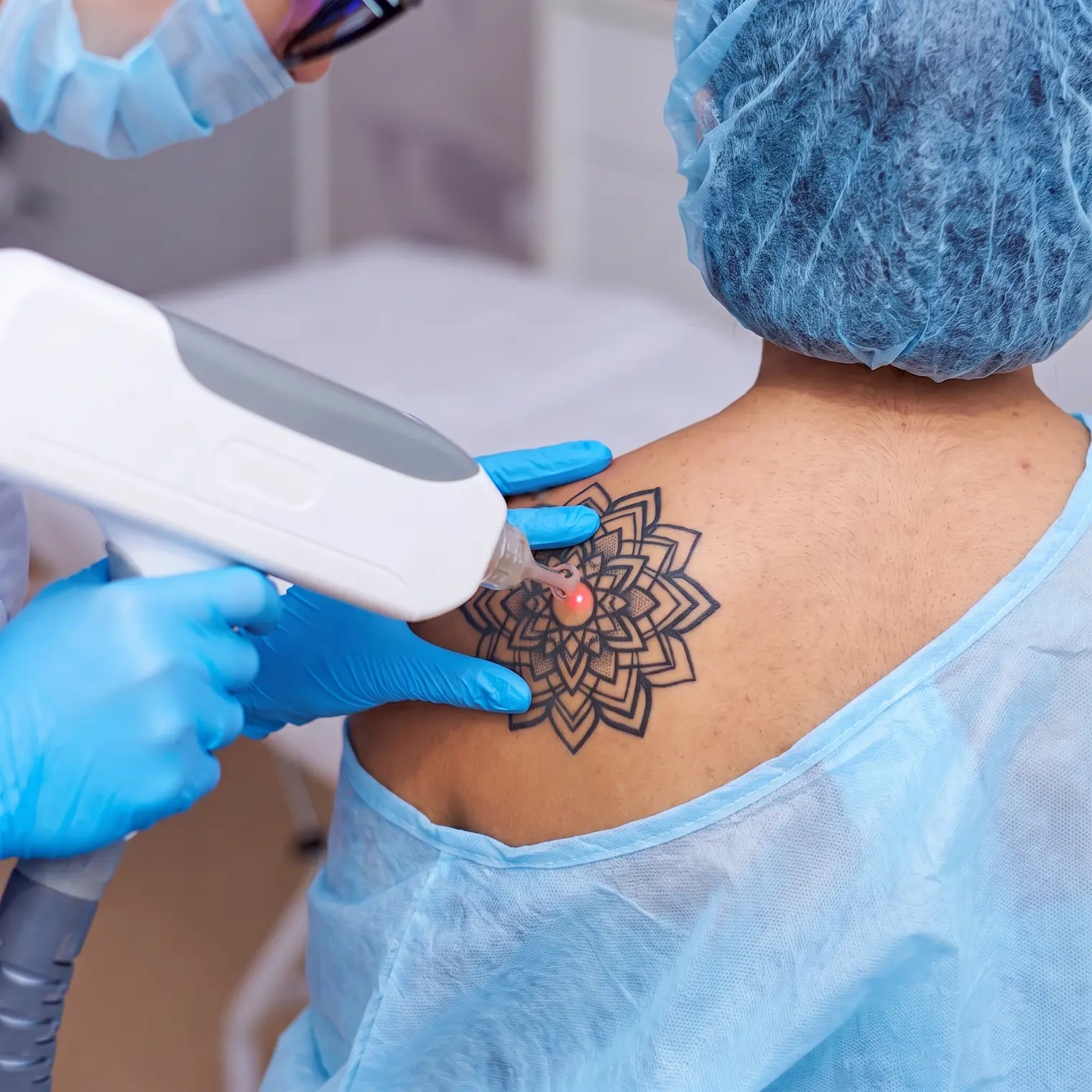
It also helps to understand what removal is actually doing to your skin, because the mechanics explain why estimates are so hard to nail down in a single consultation. A laser does not erase ink. It shatters ink particles into fragments small enough for your immune system to carry away over the following weeks. That means every session is really two things happening in sequence: the treatment itself, which takes minutes, and the clearance period afterward, which takes your body doing quiet, invisible work you cannot rush or fully predict from a single visual assessment.
"I quoted her six sessions because that's what the ink looked like on paper. She needed eleven, and honestly, I should have told her that from the start."
A Nashville laser tech, on a client's forearm piece
Get Our Recommended Nashville Clinics
Submit your details and receive our trusted recommendations for tattoo removal in Nashville.
That is not an unusual story. It is close to the norm. A client comes in with a solid black outline tattoo, maybe some grey shading, done a few years back. The tech looks at it, does the math based on standard industry averages, and quotes six to eight sessions. Everyone nods, the plan sounds reasonable, and the client books their first appointment feeling confident about the timeline.
Then session four happens. The fading has slowed down noticeably. Session six comes and goes, and there is still visible pigment, especially in the denser black areas. By session eight, what looked like it would be a wrap two sessions ago is still hanging on. The client is now paying for sessions nobody mentioned at the start, and understandably, they are frustrated. Not because the removal is going badly. Because the original number was never realistic.
Full clearance is possible, it just takes realistic planning.
Laser tattoo removal works by breaking ink particles into fragments small enough for your body's immune system to carry away naturally. Every session breaks up more ink than the last, but the process is not linear. Early sessions often show dramatic fading because they are breaking up the ink sitting closest to the surface. The ink packed deeper, or layered from touch-ups and cover-up work, takes longer to reach and longer to clear.
A consultation estimate is built on visual assessment alone. A tech looks at your tattoo, checks the ink color and apparent density, asks how old it is, and gives you a number based on averages. What that quick assessment cannot see is how deep the ink actually sits, how your specific immune system clears fragmented pigment, or whether there are layers of ink underneath the visible surface from touch-ups you may not even remember getting.
Ink Density
Solid, saturated color fields (especially black and dark navy) hold far more pigment per square inch than fine line work. More pigment means more sessions to fully break it down.
Ink Depth
Amateur and stick-and-poke tattoos are often inconsistent in depth, sometimes going deeper than professional work. Deeper ink is harder for the laser to reach effectively.
Layering & Touch-Ups
A tattoo that was touched up once or twice over the years often has 2 to 3 effective layers of ink stacked on top of each other, even if it looks like a single tattoo.
Your Immune Response
Removal depends on your lymphatic system clearing fragmented ink. This varies significantly person to person, and factors like circulation, hydration, and overall health all play a role.
Ink Color
Black responds best to laser treatment. Greens, light blues, and whites are notoriously stubborn and can add several sessions to a realistic timeline.
Location on the Body
Areas with better circulation, like the chest and upper arms, tend to clear faster than the hands, feet, or ankles, where lymphatic flow is slower.
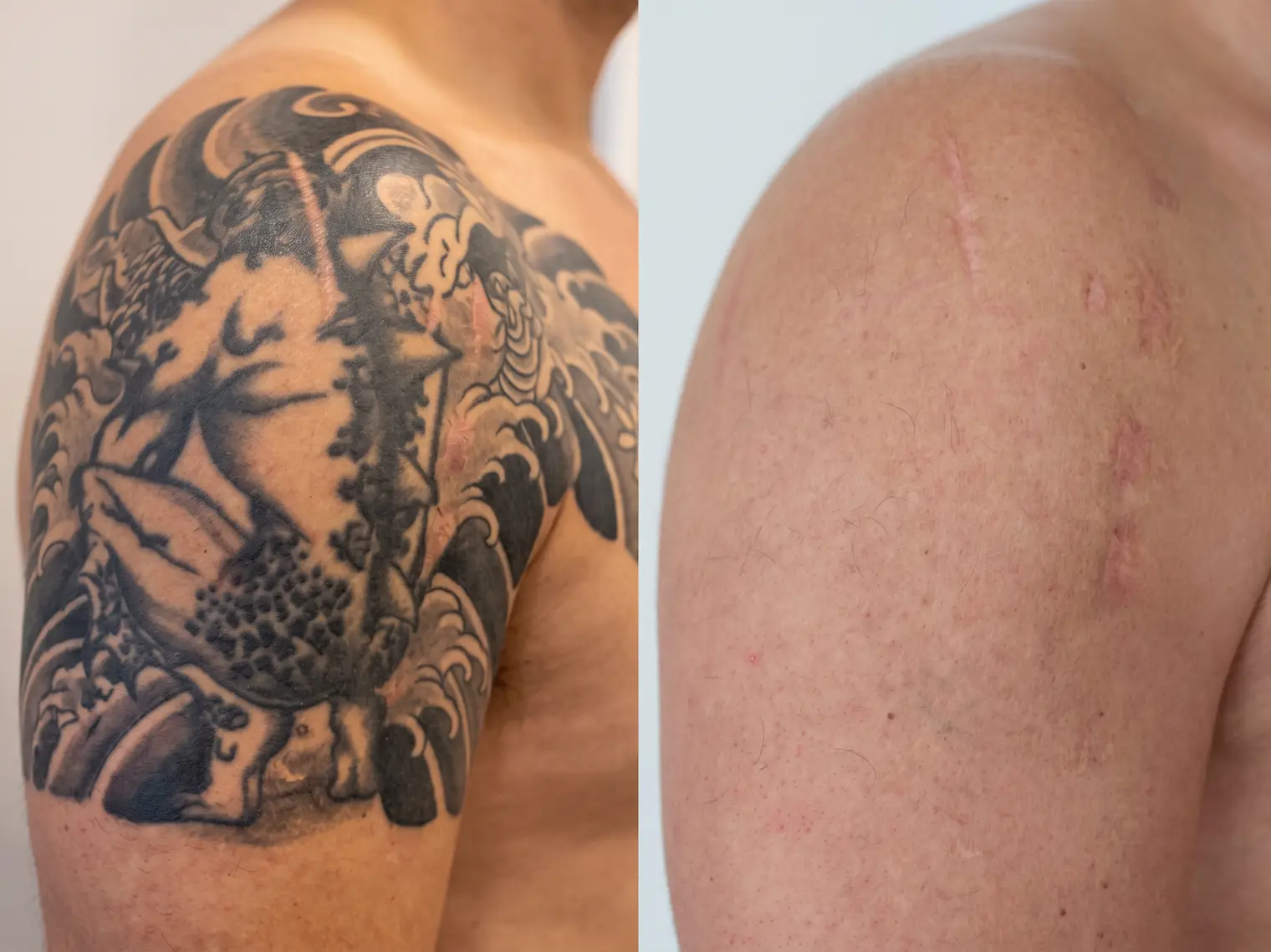
Instead of a single number, think of removal as a range that depends heavily on the six factors above. A small, simple, black-only tattoo on a well-circulated area might be a 4 to 6 session job. A large, dense, multi-color piece with visible layering could reasonably take 10 to 15 sessions, sometimes more.
1-3
Early Sessions
The most dramatic visible fading happens here. Surface ink breaks down quickly, and clients often feel encouraged by how fast things seem to be moving.
4-7
The Plateau
Progress slows visibly. This is normal and expected, not a sign something is wrong. Deeper and denser ink takes more sessions to clear than surface pigment.
8-12
Chasing the Last Ink
For larger or older tattoos, this stage focuses on stubborn pockets of pigment and any layered touch-up ink that was invisible until the top layers cleared.
13+
Full Clearance
Reserved for large, dense, multi-color, or heavily layered pieces. Not the norm, but not rare either for bigger tattoos with complex ink history.
Myth
If it is taking more sessions than quoted, the tech is bad at their job or using a weak laser.
Fact
Session count is driven far more by your specific ink and body than by the equipment or the technician's skill. A good tech gives you an honest range, not a falsely low guarantee.
Myth
You can speed things up significantly by booking sessions closer together.
Fact
Your body needs time between sessions to clear fragmented ink through the lymphatic system. Sessions spaced too close together increase risk without meaningfully shortening the timeline.
Myth
A tattoo that looks mostly faded after 4 sessions is nearly done.
Fact
Visible fading slows dramatically as you clear deeper layers. A tattoo that looks 70% faded may still need 40% of its total sessions to reach full clearance.
These ranges are general guidelines based on typical cases, not a substitute for an in-person consultation. Your actual count depends on the specific factors covered above, and each additional session adds to the total cost of removal, which is worth budgeting for realistically from the start. If a long timeline does not fit your budget or your patience, partial removal to fade the piece before a cover-up is often a faster and cheaper path to the result you actually want.
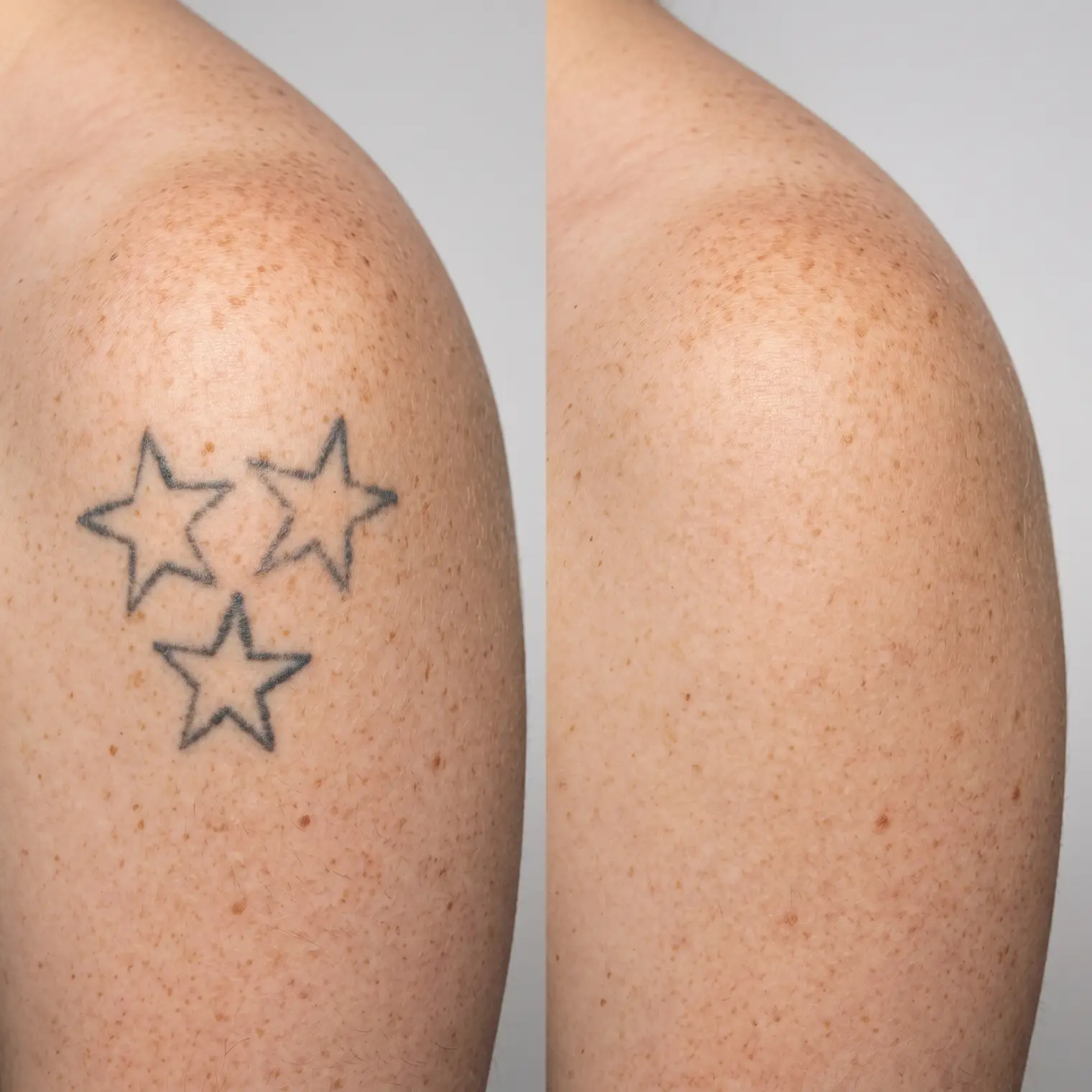
Small, Black Only
4-6
Fine line, single color, well-circulated area
Medium, Mixed Ink
7-10
Some color, moderate density, possible touch-ups
Large or Layered
11-15+
Dense color, cover-ups, or heavily layered work
The single best thing you can do before starting removal is to ask direct questions at your consultation instead of just accepting the first number. Ask what factors could push the session count higher than the estimate. Ask whether the quote accounts for any visible layering or touch-up work. Ask what percentage of their clients finish within the quoted range versus needing additional sessions.
A technician who gives you a straight, sometimes less flattering answer to those questions is one you can trust with your skin and your budget. One who insists on a suspiciously low, confident number without asking to see the tattoo up close in good lighting is giving you a sales pitch, not a medical estimate.
While you cannot change how deep your ink sits or rewrite your own immune system, there is a real amount of control you have over how efficiently your body clears each round of treatment. This is the part most consultations skip entirely, and it can meaningfully affect whether you land on the low or high end of your estimated range.
Hydration matters more than most people expect. Your lymphatic system, the part of your body responsible for carrying away the fragmented ink particles, relies on adequate fluid intake to function well. Clients who show up dehydrated to sessions, which happens more often than you would think, tend to see slower clearance between appointments.
Sun exposure is the other major factor within your control, and it works against you in two directions. Tanned or sun-damaged skin absorbs more laser energy at the surface, which both increases discomfort and reduces how much energy reaches the actual ink. Most reputable clinics in Nashville will ask you to stay out of direct sun for several weeks before and after each session, and skipping that instruction is one of the most common reasons a treatment plan runs longer than expected.
Finally, spacing matters, but not in the direction most people assume. There is a real temptation to book sessions as close together as your clinic allows, hoping to speed things along. In practice, going too fast without giving your body enough time to fully process the previous round of fragmented ink is more likely to extend your overall timeline than shorten it, since it can lead to skin irritation that forces a delay in your next appointment.
Not Sure Which Nashville Clinic Is Worth Your Money?
Tell us a bit about your tattoo and we will point you to trusted, experienced removal specialists in Nashville, no sales pressure.
Thanks! We will match you with the right clinic shortly.
✓
Reviewed by a tattoo artist with over 10 years of industry experience, who has watched laser removal technology and technique improve dramatically over the past decade and regularly advises clients on full removal versus partial fading for a cover-up.
Why did my consultation quote turn out to be too low?
Consultation quotes are based on a visual estimate, not a full picture of ink depth or layering beneath the surface. It is common, not a sign of a bad estimate or poor technique, for the final session count to run higher than the initial number given at your first visit.
Does a more powerful laser mean fewer sessions?
A capable, well-maintained laser matters, but session count is driven more by your ink's depth, density, and color, and by your body's own clearance rate, than by the specific machine used.
Can I speed up the process by getting sessions more frequently?
No. Your lymphatic system needs adequate time between sessions to clear fragmented ink safely. Rushing sessions increases risk of skin damage without meaningfully shortening your total timeline.
Is it normal for progress to slow down partway through?
Yes, this is one of the most consistent patterns in laser removal. Early sessions clear surface ink quickly, and progress naturally slows as treatment reaches deeper or denser pigment.
Should I get a second opinion if I feel my session count is off track?
If your progress feels significantly different from what was discussed, a second consultation with another reputable clinic is a reasonable step, and most honest technicians will not be offended by it.
Do stick-and-poke tattoos need more or fewer sessions than machine tattoos?
Stick-and-poke tattoos can sometimes need more sessions, since hand-poked ink is often applied at inconsistent depths, making it harder for the laser to reach every particle evenly compared to a professionally machine-applied tattoo.
Does a tattoo with many ink colors need more sessions than a black-only tattoo?
Generally yes. Each color often responds best to a specific laser wavelength, so a multi-color tattoo may need additional passes or even a different laser type compared to a single-color black tattoo.
Does an older tattoo need fewer sessions than a recent one?
Not necessarily. While some older tattoos have naturally faded somewhat over time, ink depth and density matter more than age alone, and a well-preserved older tattoo can still need a full session count.